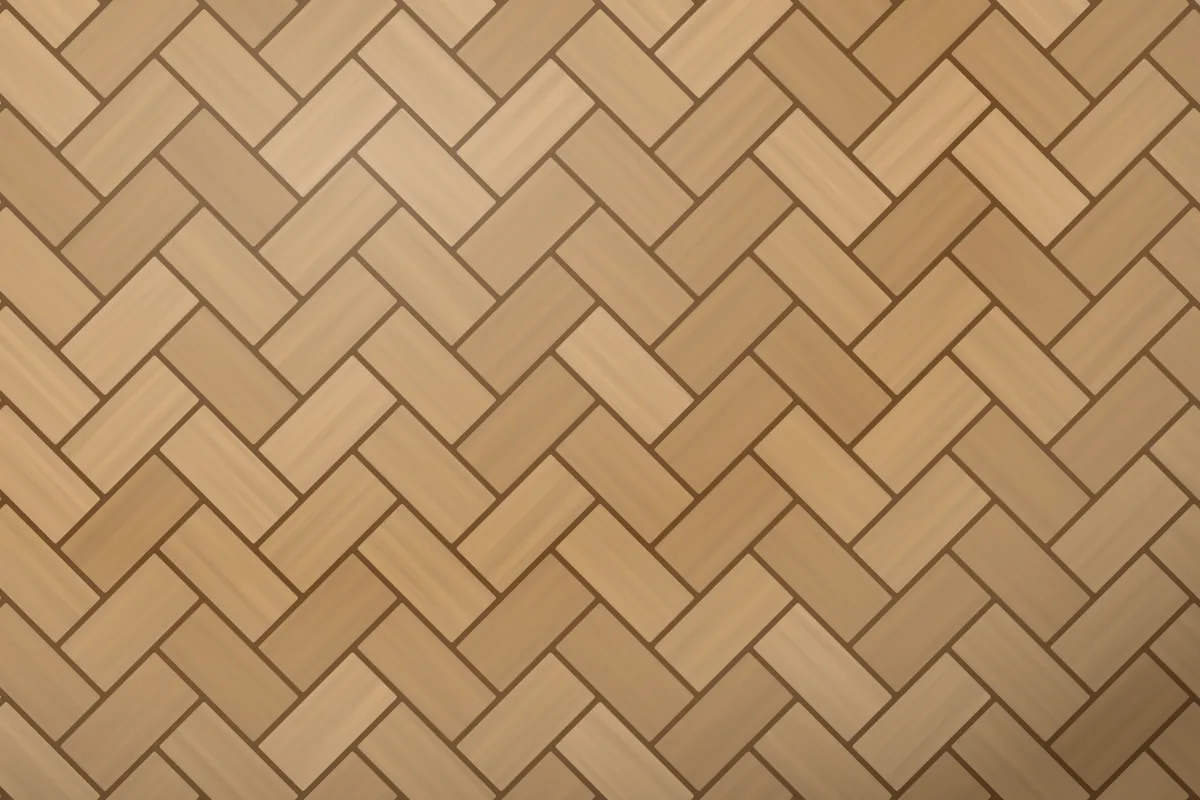
Herringbone flooring is a pattern where rectangular planks or tiles are laid at 90-degree angles to each other, forming an interlocking V-shape — it can be made with engineered wood, LVT or parquet blocks.
What Does Herringbone Look Like?
The herringbone pattern uses rectangular planks laid at 90 degrees to each other in alternating rows. The end of one plank meets the side of the next at a right angle, forming a continuous zigzag pattern across the floor.
True herringbone uses a 90-degree angle. Chevron is the similar-but-different version where the ends of the planks are cut at an angle (usually 45 degrees) so the V-points meet precisely. Herringbone has offset points; chevron has perfect meeting points. Both are popular but herringbone is more common in the UK.
What Materials Can Be Laid in Herringbone?
Engineered wood — the most popular choice for herringbone in the UK. Narrow planks (typically 90–120mm wide) in a 90-degree herringbone layout. Can be glue-down or floating.
LVT (Karndean, Amtico) — both brands produce herringbone-format tiles and planks specifically for this pattern. LVT herringbone is fully waterproof, making it suitable for kitchen-diners where engineered wood is not.
Parquet blocks — the original herringbone, made with small solid wood blocks. Less common in new installs now, but FitFloors fits parquet restoration and new parquet where required.
Ceramic and porcelain tile — herringbone tile patterns are popular in bathrooms and kitchens. Tile fitting is not a FitFloors service.
How Much Does Herringbone Flooring Cost to Fit?
Herringbone fitting costs 30–50% more than a straight lay of the same material. A standard engineered wood straight lay costs £15–£22 per m² for labour; herringbone costs £20–£35 per m² for the same material.
The reason: every single plank must be individually measured, cut at precise angles and placed correctly. There is more waste (off-cuts), more time spent cutting and checking, and less margin for error. On a 20m² room, the herringbone fitting premium adds roughly £100–£250 to the labour cost compared with straight lay.
| Room size | Straight lay labour | Herringbone labour | Difference |
|---|---|---|---|
| 15m² | £225–£330 | £300–£525 | £75–£195 |
| 20m² | £300–£440 | £400–£700 | £100–£260 |
| 25m² | £375–£550 | £500–£875 | £125–£325 |
Which Direction Should Herringbone Run?
The classic direction is diagonal to the room — at 45 degrees to the walls. This gives the most dynamic visual effect and makes the room feel larger.
Herringbone laid parallel or perpendicular to the walls (0 or 90 degrees) gives a more structured, formal look. It is also slightly easier to fit because the edge cuts at the room's perimeter are simpler.
FitFloors will discuss direction with you at the quote visit and show you the options before starting.